The Irrelevance Trap: Why AI Doesn’t Replace Jobs, It Replaces Static Thinking
The current discourse on AI is paralyzed by a fundamental misunderstanding of labor. We are not witnessing the automated erasure of the human worker; we are witnessing a brutal recalibration of human value. While the headlines focus on the specter of "job replacement," they miss the strategic reality: AI is not a creator of intent, but an amplifier of it.
The battlefield of the next decade is not "AI vs. Humans." That is a category error. The true competition is an internal war within the workforce: a struggle between those who cling to static technical depth and those who evolve into strategic, mission-driven operators. In this new economy, the machine does not take your job; a sharper, more adaptive, AI-leveraged version of your peer does.
The Amplifier Effect: The Trap of Faster Mediocrity
The most dangerous misconception in modern management is that the tool itself creates value. In reality, AI functions as a force multiplier for the quality of the operator’s mind. If the underlying logic is flawed, AI simply scales that flaw with terrifying efficiency.
History confirms this trajectory. Spreadsheets did not eliminate accountants; they eliminated slow accountants who could not provide strategic insight beyond the ledger. Email did not replace managers; it replaced those who lacked the agility to operate in real-time. Cloud computing did not render IT obsolete; it dismantled rigid, legacy infrastructures in favor of fluid systems.
"AI is an amplifier. It does not create intent."
A mediocre thinker with AI produces mediocrity at a higher velocity. Conversely, a strong operator produces asymmetric results—output that was previously impossible for a single individual to achieve. The risk is not the bot; the risk is "faster mediocrity."
The Judgment Moat: Decision Quality Under Uncertainty
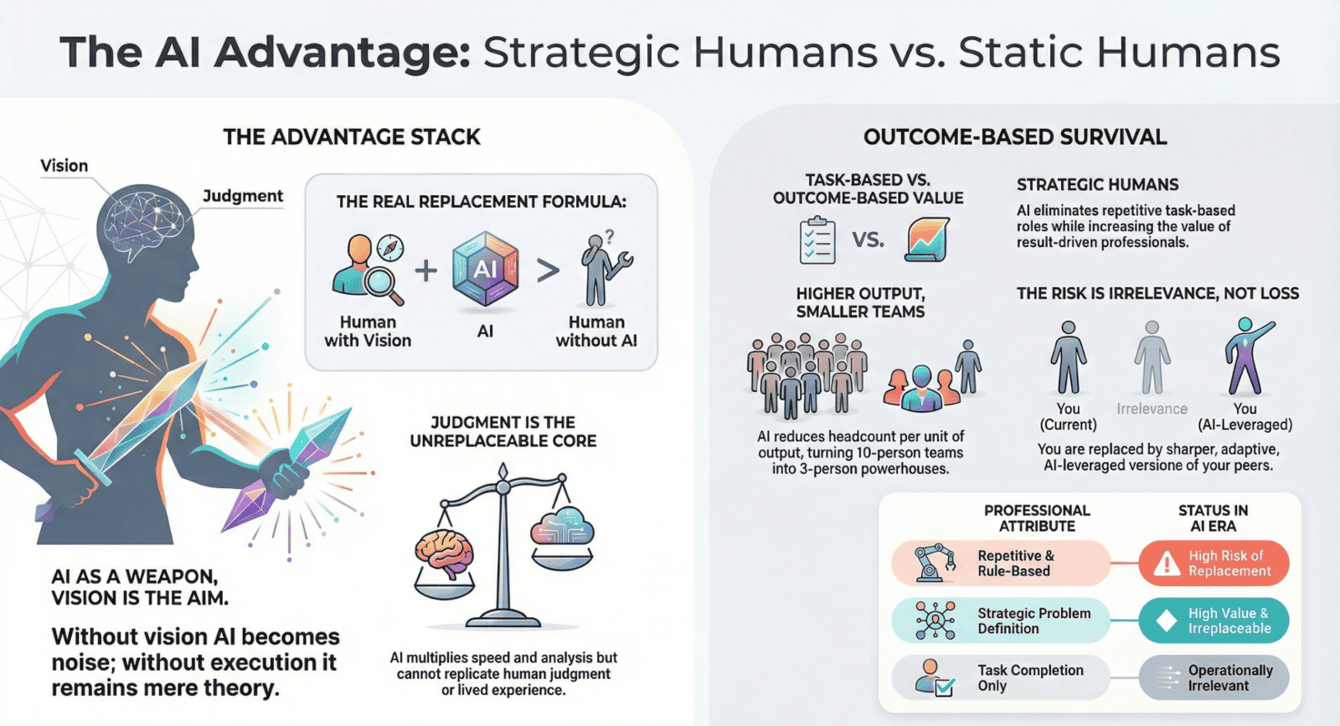
As AI commoditizes technical execution, human value is being forced up the "Advantage Stack." While AI can replicate speed, analysis, and even synthesis, it cannot cross the final moat of professional relevance: Judgment.
The Advantage Stack consists of:
- Clear Vision: Knowing where value is going.
- Structured Thinking: The ability to break chaos into workable models.
- Execution Bias: The drive to ship fast and iterate faster.
- AI Leverage: Multiplying speed, analysis, and content production.
- Judgment: Decision quality under uncertainty.
AI is exceptionally proficient at the first four layers, but it fundamentally lacks Judgment. Judgment is derived from pattern recognition, lived experience, and—most importantly—an understanding of consequences. The machine can solve for the "how," but it cannot weigh the "should." In a world of infinite automated options, the human who can navigate uncertainty to make a high-stakes call becomes the ultimate premium asset.
Weaponizing the Outcome: Vision and Execution
The market is aggressively devaluing task-based labor. If your role is defined by repetitive, rule-based actions or the mere completion of tickets, you are already obsolete. The "Real Replacement Formula" dictates the new hierarchy:
(Human with Vision + AI) > (Human without AI)
To survive this shift, one must stop being a "task-doer" and start being an "outcome-owner." This requires viewing AI not as a novelty, but as a weapon.
AI is a weapon. Vision decides where to aim. Execution decides whether you win. Without vision, AI becomes noise. Without execution, AI becomes theory. The future belongs to mission-driven operators who use AI for force multiplication, defining the problems and designing the systems rather than just filling the seats.
The Efficiency Paradox: The 10-to-3 Shift
We must be unsentimental about the "Hard Truth" of market displacement. Displacement happens not because AI has achieved consciousness, but because it drastically reduces the number of people required per unit of output. This efficiency paradox means that while the volume of work may increase, the headcount required to sustain it will collapse.
The math is already shifting in high-output environments:
- A 10-person content team is being distilled into a 3-person AI-augmented powerhouse.
- A 5-person analytics department is replaced by a single, high-agency data strategist utilizing sophisticated AI tooling.
This reduction is inevitable. However, the professionals who remain—those who are high-ownership and AI-fluent—become exponentially more valuable. They are no longer cogs in a machine; they are the architects of it.
The War of the Humans: Strategic vs. Static
The evolution of AI has fundamentally altered the "Moat" of professional success. For decades, technical depth was the primary barrier to entry. That moat is shrinking. As AI levels the playing field for technical execution, the advantage shifts toward curiosity, speed, systems thinking, and cross-domain synthesis.
This creates a generational divide that has nothing to do with age and everything to do with adaptability. Generations that adapt the fastest win; those who were "first" to a specific technical skill often lose.
The competition is Strategic Humans vs. Static Humans. A Static Human relies on a fixed skill set and resists tool evolution, hoping their tenure or technical depth will save them. A Strategic Human recognizes that technical depth is being commoditized and pivots toward owning the mission and the outcome.
The Risk of Irrelevance
The ultimate danger of the AI era is not a sudden layoff, but a slow descent into operational irrelevance. In a fast-moving market, irrelevance is a death sentence. As the threshold for technical execution drops to near zero, the value of human agency and vision scales to infinity.
The risk is not that a machine will take your desk; the risk is that you will remain a task-oriented worker in an economy that only rewards outcome-oriented leaders. Irrelevance is always replaced.
Are you currently a static human performing tasks, or a strategic human owning outcomes?